
A Quiet Start: A Beginner Yoga Practice
Start with the idea that a beginner practice can be small. You do not need to make the first session complicated, and you do not need to move through a long sequence. Movenestra treats beginner yoga as an invitation to notice how you move, how you breathe, and how comfortably you can stay present with a simple shape.
Choose a clear patch of floor and give yourself enough room to extend an arm or a leg without touching furniture. A folded towel or blanket can make the floor feel more comfortable. Before you begin, decide that the goal is to practice slowly rather than to reach a particular pose.
Begin with standing and breathing
Stand with your feet in a comfortable position. Let your arms rest by your sides. Notice where your feet meet the floor. Take a few unhurried breaths without trying to make them unusually deep. Let your shoulders soften. If it helps, keep your eyes open and allow your gaze to rest on one spot.
From there, raise your arms slowly and lower them again. Repeat the movement several times. The useful part is the coordination: the arms rise while you inhale comfortably and lower while you exhale comfortably. There is no need to force the breath to match a fixed count.
Move through a few familiar shapes
Try a gentle standing fold by bending your knees slightly and letting your upper body tip forward. Your hands can rest on your thighs or on a stable surface. Return to standing slowly. Repeat once or twice, noticing how your balance changes as your head and torso move.
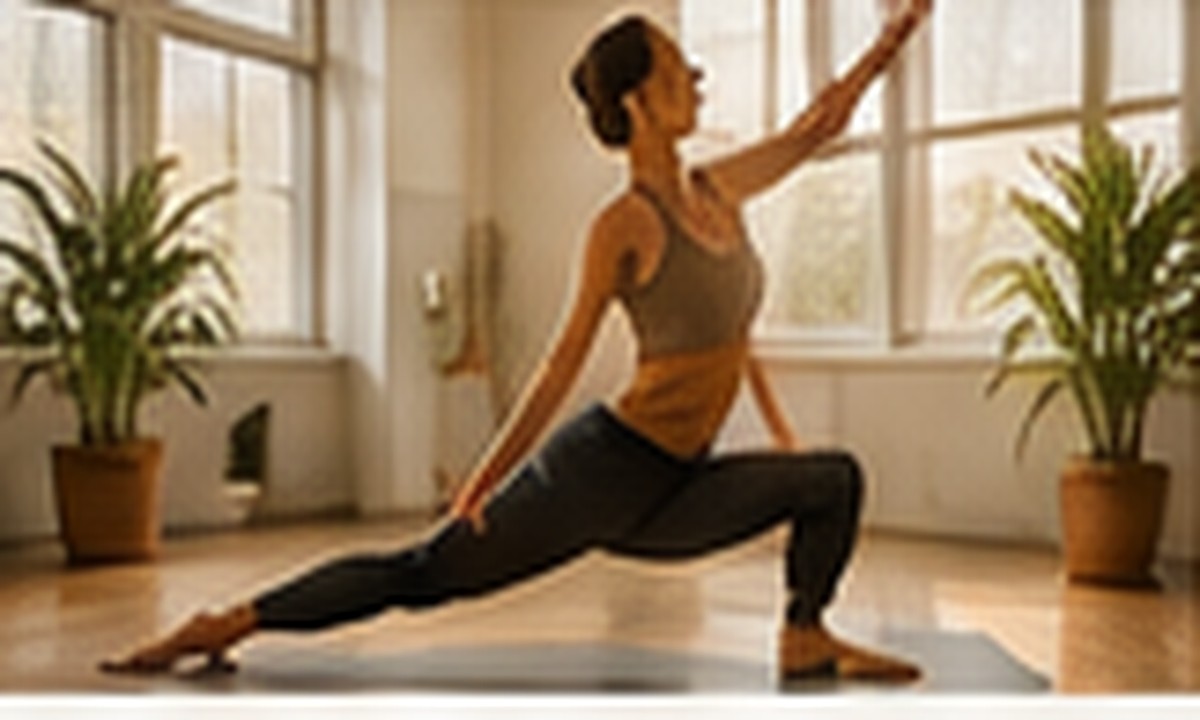
Next, step one foot back into a short, comfortable lunge. Keep the front knee in a position that feels controlled. Stay upright instead of chasing a deep stretch. Switch sides. The aim is to explore the shape, not to test how far it can go.
Come down to a seated position and extend one leg at a time in front of you. Sit tall, then gently turn your torso to one side. Return to center before turning the other way. Small ranges are enough. A simple seated twist can be an opportunity to notice your rib cage, shoulders, and breath rather than an attempt to rotate as far as possible.
Finish on the floor
Lie on your back with your knees bent and feet on the floor. Let your hands rest over your ribs or at your sides. Stay there for several slow breaths. Notice the support beneath you. Then extend the legs only if that feels comfortable. Otherwise, keep the knees bent.
A beginner session can finish with one minute of quiet. Nothing needs to happen during that minute. Notice the floor, the movement of your breath, and any areas you are holding tightly. Then roll to one side and return to standing slowly.
Keep the first weeks simple
Consistency is easier to build when the practice feels approachable. You might repeat this sequence on several days and make only one small change at a time. Add a few minutes, change one movement, or spend longer in the final rest. Keeping the structure familiar gives you room to notice what is changing in your own practice.
You can also keep a tiny practice note after each session: what felt steady, what felt awkward, and what you would like to repeat. The note is not a score. It is simply a way to remember what you noticed.
Beginner yoga does not have to look impressive. A quiet sequence, a comfortable range of motion, and a few attentive breaths can be enough for one session. Let the practice stay useful, repeatable, and easy to understand.
Let the sequence teach you the pace
One useful way to stay relaxed is to leave a small pause between shapes. After a fold, stand up and breathe before stepping back. After a twist, return to the center and notice the position of both feet. Those pauses prevent the sequence from becoming a race through familiar names.
You can also practice the same short sequence with less range on a busy day. A smaller lunge, a shorter fold, or a seated version of a movement still gives you something concrete to practice. Keep the order familiar and change only the size of the movement.